
Pillar guide: Land, rights and services
Legga questo articolo in italiano.
Buying an olive grove in Italy: felling rules and Xylella
On this page
Buying an olive grove in Italy means buying trees the law protects. A national decree from 1945 bans felling more than five olive trees every two years without permission, and some regions go further, such as Calabria for uprooting and Apulia (Puglia) for monumental olive trees. In Apulia owners must also work the soil every spring against the insects that spread Xylella. The rules described are those in force on 12 November 2026.
In short
- National law bans felling more than five olive trees every two years; beyond that you need permission, given only for dead trees, trees that no longer produce for causes that cannot be removed, or trees planted too densely (Decree 475/1945, Articles 1 and 2).
- Regions can be stricter: in Calabria uprooting is banned except in the cases its regional law allows, and doing it without permission costs €500 to €3,000 per tree, up to €100,000 (Calabria Regional Law 48/2012, Article 8).
- In Apulia, damaging, felling, uprooting or selling monumental olive trees on the regional list is banned, except for derogations only in the cases and under the procedure of Article 11, which requires, among other things, the binding opinion of a regional committee and replanting of every tree; monumental groves carry a landscape constraint (Apulia Regional Law 14/2007, text in force).
- Across Apulia, owners and tenants of farmland must work the soil each spring against the insects that spread Xylella; in 2026 the windows ran from 25 March to 15 May, depending on the comune’s altitude.
5 trees
May be felled every two years without permission
Beyond that number you need permission; regional laws may add conditions.
€500–3,000
For each olive tree uprooted without permission in Calabria
Up to a maximum of €100,000, with replanting where possible.
22.7 q/ha
Average olive yield in Italy in 2025
It was 30.7 quintals per hectare in 2006 (ISTAT); a quintal is 100 kg.
The report brings together public information about the land, with sources and dates, to prepare questions for the relevant offices: €29 in English or Italian · €39 in both languages · total, VAT included.
What national law protects
Olive trees are one of the few crops an Italian landowner cannot remove at will. Decree 475/1945, a Lieutenant’s Legislative Decree still in force, bans felling more than five olive trees in any two-year period. The ban also covers trees in decline for any reason, and those damaged by acts of war, if special cultivation work can bring them back into production (Article 1).
Beyond five trees you need permission, and the law allows it in three cases only: the tree is dead, it has stopped producing for causes that cannot be removed, or the grove is planted so densely that the tree harms it (Article 2). The national text gives the decision to the Chamber of Commerce, after a check by the provincial agriculture inspectorate. On the inspectorate’s proposal, the owner or tenant can be ordered to plant the same number of olive trees, on that land or on other land they own or farm, in the manner and by the date set (Article 3).
| Case | National rule | Source |
|---|---|---|
| Up to five olive trees in two years | Felling allowed | Art. 1 |
| Declining tree that can recover | Covered by the ban like a healthy tree; not a ground for permission | Arts. 1 and 2 |
| Tree dead or unproductive for causes that cannot be removed | Permission needed | Art. 2 |
| Grove planted too densely, harming the trees | Permission needed | Art. 2 |
| Felling without permission, or replanting not done | Ten times the value of the trees, counted in full production | Art. 4 |
Article 4 began as a criminal fine; the updated text published by the Lazio Region lists it as an administrative penalty of the same amount, ten times the trees’ value. Before the deed, ask the seller for the permissions behind any missing or recently felled trees. A diseased tree that cultivation work could bring back into production is not a ground for permission: felling it counts towards the limit of five trees in two years.
- Up to 5 trees in two yearsAllowed by national law; in Calabria with prior notice
- Tree dead or unproductive for causes that cannot be removedPermission needed
- Grove planted too densely, harming the treesPermission needed; replanting can be ordered
- Any other case, including declining trees that can recoverBanned beyond 5 trees; penalty of ten times the trees’ value
Sources: Decree 475/1945, Article 1; Decree 475/1945, Article 2; Calabria Regional Law 48/2012; Apulia Regional Law 14/2007, text in force; accessed 12 November 2026.
Regional rules: Calabria as an example
Regions can set their own rules on exceptions. In Calabria, Regional Law 48/2012, as amended by Regional Law 20/2014, replaces the exceptions of the 1945 decree and bans uprooting olive trees “in any vegetative state” except in the cases it allows. The only carve-outs are ornamental olives in gardens and parks and those in plant nurseries; monumental olive trees on the regional Register can never be uprooted (Article 3).
The owner, or a tenant with the owner’s written consent, applies to the region’s agriculture department (Article 4):
- Dead tree. Permission to uproot once physiological death is confirmed.
- Dense planting, public works, buildings. Uprooting can be allowed, with replanting, if density harms the grove or uprooting is essential for the works; for buildings, the sheds, farm buildings or fixed greenhouses must already hold every permit.
- Land improvement. Separate rules in Article 5, set out below.
- Up to five trees in two years. Allowed without permission, but with prior notice to the office.
The department decides within landscape constraints and keeps in place any commitments tied to public grants. Heavy pruning, meaning cutting the trunk back to its base, also needs permission, and rejuvenation pruning or pruning for mechanical harvest that removes the main branches is banned (Article 6).
For land improvement, Article 5 sets two routes. Farms with more than one hectare of olive grove can renew up to 50% of the cadastral olive area with new olives in a rational planting layout. They can also switch 50% of that area to other fruit trees, transplanting or keeping at least 30% of the uprooted olives along the parcel edges. Below one hectare permission can cover the whole area, with at least 40% of the trees transplanted or kept along the edges. An agronomist’s technical report with a project and business plan is always required. There is also a regional cap: over ten years, land improvement works may not cover more than 5% of Calabria’s entire olive area, as measured by the ISTAT data of the sixth agricultural census (Article 5, paragraph 6). Meeting the conditions on a single farm therefore does not guarantee permission; the agriculture department makes the assessment.
Monumental olive trees in Apulia
Apulia Regional Law 14/2007, in the text in force published by the regional council with amendments up to Regional Law 14/2023, protects monumental olive trees, including single trees. An olive tree is monumental when its age of several centuries can be inferred from a trunk at least 100 cm across, measured 130 cm above the ground, or from documented historical value. A trunk of 70 to 100 cm is enough if it has a sculptural shape, if a community gives it symbolic value, or if it stands next to protected historic, artistic or archaeological sites; a 2012 regional circular confirms these criteria. A grove can be monumental if at least 60% of the trees in the cadastral parcel are.
The regional executive updates the list of monumental olive trees every year and publishes it in the regional Official Bulletin with cadastral references. Owners have 30 days from publication to lodge a reasoned objection; once the list is final, monumental groves automatically fall under a landscape constraint (vincolo paesaggistico). Damaging, felling, uprooting and selling listed trees is banned (Article 10).
Derogations from the ban are possible solely in the cases of Article 11, paragraph 1:
- public-interest grounds;
- works whose permit procedures were already complete when the law came into force;
- implementing plans under general town plans brought into line with Apulia Regional Law 56/1980, located in zones B and C (zone omogenee, the planning zones of Ministerial Decree 1444/1968) and with mixed residential use;
- infill areas classed as zone B under Decree 1444/1968 within built-up centres whose limits are set under the Highway Code;
- works in Special Economic Zones (ZES).
A derogation is granted under the procedures of Law 144/1951 and only after the binding opinion of the regional technical committee, which checks that the conditions are met and weighs the purpose of the removal, documented proof that there is no alternative and the plan to replant every tree removed.
Replanting must take place on free land within the same building or planning unit of the works; only if that is shown to be impossible may it go to other suitable public or private land, precisely identified and preferably adjoining (paragraph 3).
In Natura 2000 sites the habitats assessment (valutazione di incidenza) still applies, and in national and regional protected areas the managing body must give clearance (paragraph 4). The permission lasts two years and cannot be extended.
The trees may never be sent or moved for nursery or ornamental use (paragraph 2), and replanting is paid for by whoever carries out the works (Article 12). On land with many monumental trees, land improvement must not damage them; small works serving the farm that need limited moves of monumental trees within the same parcel can be allowed with the committee’s opinion (Article 13).
From the publication of the list, anyone who breaches Articles 10, 11, 12, 13 and 15 (ban, derogations, replanting, land improvement, transitional rules) pays €3,000 to €30,000 for each tree concerned, up to €250,000, unless a more serious offence applies (Article 17).
What a landscape constraint means for works, fences and buildings is covered in the guide to the vincolo paesaggistico. For any part of the land classed as woodland, see the guide to woodland rules in Italy.
Xylella: what owners must do in Apulia
Xylella fastidiosa is a bacterium with outbreaks in every Apulian province. It spreads mainly through insect vectors whose young stages grow on wild grasses between March and April. To fight those young stages, decision no. 39 of 11 March 2026 of the region’s Plant Health Observatory makes shallow soil work compulsory throughout Apulia: ploughing, rotary tilling, harrowing, or mulching with grass cut to 10 cm at most. The measure applies the regional action plan for 2025–2027, approved by Resolution 1075 of 29 July 2025.
The duty falls on owners and tenants of farmland, and on owners or managers of uncultivated farmland, green spaces, road verges and canals. Where machines cannot reach, such as slopes and verges, physical methods like flame or steam weeding are used, and herbicide only if those are impossible. On land under arable crops, fodder or pasture where there are olive, almond or other stone-fruit trees, the work is done only under the canopy. Protected natural areas (except the olive groves, orchards and vineyards inside them), woods, pine woods and private gardens are excluded. Checks are carried out by the Carabinieri Forestali.
If you buy between March and May, the preliminary contract should say who does that year’s soil work. The boundaries of the infected and containment zones are published and updated by the regional Plant Health Observatory.
Yields, landscape and what the report shows
What an olive grove is worth depends on what it produces. According to ISTAT, Italy’s statistics office, the average olive yield fell from 30.7 quintals per hectare in 2006 to 22.7 in 2025 (a quintal is 100 kg). Over the same period output dropped by 27.2% while the area under olives shrank by only 1.4%, so almost all of the fall comes from yield. In 2025 olives covered 1,097,677 hectares. These are national averages; a single grove’s yield depends on the age and variety of the trees, irrigation and care, so ask the seller for harvest records or olive mill invoices.
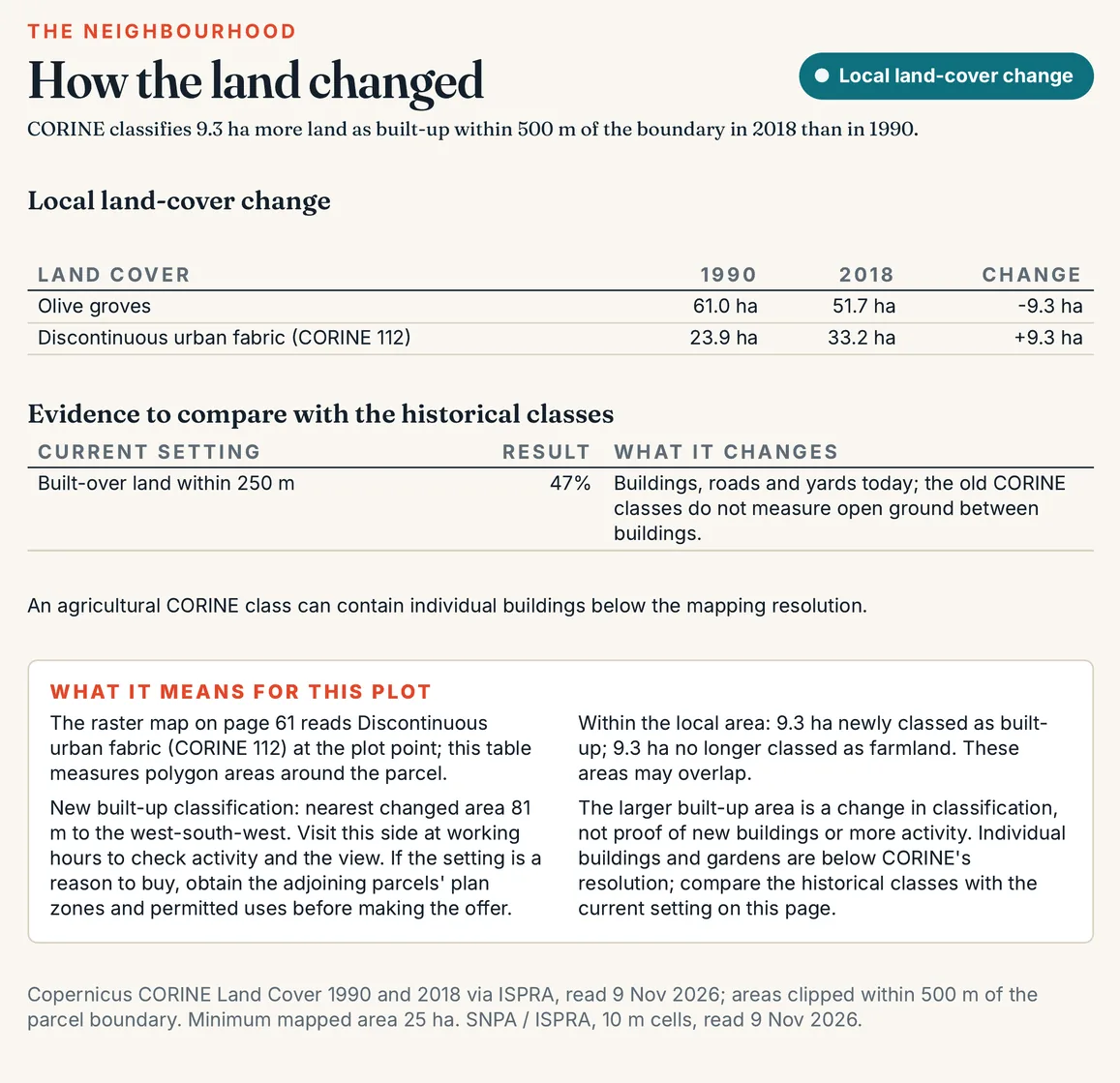
The landscape around a grove changes too. European land-cover maps show where olive groves have given way to other uses, but their smallest mapped unit is 25 hectares: they show a trend in the area, not the history of one parcel.
Before you buy: the checks in order
- Zoning and constraints. Ask the comune’s planning office for a CDU (certificato di destinazione urbanistica, the zoning certificate): it is issued within 30 days of the request and is valid for a year if the plan does not change (DPR 380/2001, Article 30). It shows whether the parcel is agricultural and carries landscape constraints. The steps are in the guide to the CDU.
- Monumental trees. In Apulia and Calabria, ask the region whether the parcel is on the list or Register of monumental olive trees.
- Past permissions. Ask the seller for copies of uprooting permissions, notices for the five trees, and any replanting still due, with its deadline.
- Public grants. Ask whether the grove received grants with commitments still running: in Calabria, uprooting permission leaves them in place.
- Xylella, in Apulia. Ask whether this year’s compulsory soil work was done and whether there were inspections or orders.
- Yields and costs. Ask for harvest records or olive mill invoices for recent years.
- Pre-emption and taxes. Check with the notary whether neighbours or tenants have a pre-emption right (prelazione agraria) and what taxes apply to buying farmland.
Hypothetical example
From olives to almonds in Calabria
A hypothetical example. A Calabrian farm has 1.5 hectares of olive grove in the land register, with 300 trees, and wants to switch to almonds. Above one hectare the regional law allows removal to be authorised on 50% of the registered olive area, here 0.75 hectares, where the new orchard must be planted. The law sets the area, not the number of trees: assume the survey counts 150 olives on the 0.75 hectares chosen. At least 30% of the trees removed, so 45, must be transplanted or kept on the edge strips of the same parcels. The agronomic report with a business plan and the agriculture department’s permission come before any tree is touched, and the department also weighs the regional cap of 5% of the olive area over ten years. A buyer of the farm asks to see the report and the permission.
Sources: Calabria Regional Law 48/2012; accessed 12 November 2026.
Buying an olive grove in Italy: felling rules and Xylella
https://terrenocheck.it/en/guide/buying-olive-grove-rules-italy
Checklist
Before the deed for an olive grove
Common questions
How many olive trees can I cut down on my land without permission?
National law bans felling more than five every two years (Decree 475/1945, Article 1). The ban also covers declining trees that can still be brought back into production. Regions can add conditions: in Calabria the five trees in two years need prior notice to the regional office, and uprooting monumental trees on the regional Register is banned in all cases.
Who gives permission to fell olive trees?
The national text names the Chamber of Commerce, after a check by the provincial agriculture inspectorate. Where a region has its own law, the office named in that law decides: in Calabria, the regional agriculture department. Before doing anything, ask your region’s agriculture office which procedure applies.
What happens if I fell olive trees without permission?
Under national law, a sum equal to ten times the value of the trees felled, counted as if in full production, now treated as an administrative penalty. In Calabria the regional law sets €500 to €3,000 per tree, up to €100,000, with replanting where possible.
How do I know if an olive tree is monumental?
In Apulia, check the regional list of monumental olive trees, published in the regional Official Bulletin with cadastral references. The main test is a trunk at least 100 cm across, measured 130 cm above the ground. Calabria keeps a Register of monumental olive trees at its agriculture department. Ask the region whether the parcel appears on either list before the deed.
If I buy an olive grove in Apulia, do I have to do the Xylella soil work?
Yes, once you own or farm agricultural land. Regional decision no. 39/2026 makes shallow soil work compulsory throughout Apulia (ploughing, rotary tilling, harrowing, or mulching with grass cut to 10 cm at most) in spring windows set each year. The Carabinieri Forestali, the police unit for forests and the environment, check that it is done.
Can I replace the olive grove with another orchard?
It depends on the region. In Calabria, farms with more than one hectare of olive grove can be allowed to switch 50% of the cadastral olive area to other fruit trees, transplanting at least 30% of the uprooted olives along the edges and filing an agronomic report with a business plan. Over ten years these works may not exceed 5% of the olive area of the whole region (Regional Law 48/2012, Article 5).
Keep reading
Buying woodland in Italy: what the forest rules let you do, and what to check before you sign
Buying agricultural land in Italy: pre-emption rights
Taxes on buying agricultural land in Italy: 15%, 9% or relief
Italy’s small farm ownership relief: who qualifies, 5-year rule
Constraints and land history, before the preliminary contract
Pick the parcel on the map: the comune’s plan, landscape constraints, protected areas and changes in land cover are read for that plot, each with a source and date, along with the questions to put to the comune and the region.
€29 in English or Italian · €39 in both languages · total, VAT included